
Natchitoches Parish Parole vs Probation
Parole and probation can both place a person under Louisiana community supervision, but they do not describe the same path. Parole normally follows physical imprisonment and allows the balance of a sentence to continue outside a facility under stated conditions. It therefore can be evidence that confinement ended, though it is not full sentence discharge. Probation may follow a suspended or noncustodial sentence. A probation entry alone does not prove that the person was ever released from the Natchitoches Parish Detention Center.
| Status | What it means | Best verification source |
|---|---|---|
| Parole | Physical imprisonment ended while the sentence continues under community supervision. | Louisiana LAVNS, the release record, and the assigned Probation and Parole district |
| Probation | A court-ordered supervision term that may follow a suspended or nonprison sentence. | The court disposition, LAVNS supervision status, and the assigned district |
| Full discharge | The applicable sentence or supervision term has ended, subject to the exact official record. | DPS&C discharge date or the court and supervising agency record |
Definition: Community supervision means an official parole or probation status outside a correctional facility. It does not by itself prove full discharge, no active case, or no warrant.
Verify Natchitoches Parish Supervision
Louisiana DPS&C identifies LAVNS through VINELink as the public route for imprisonment and community-supervision information. DPS&C says the information updates every 24 hours, so it is a dated status lead rather than a real-time officer record. Use this sequence for one person:
- Search the person in the Louisiana LAVNS person search by name or an available ID or case number.
- Compare the person’s identity, supplying agency, status, and location. Never select a record by name alone.
- Read the label exactly. “Probation,” “parole,” “community supervision,” and “released” carry different meanings.
- Identify the responsible district. Do not assume the parish jail is the reporting office.
- Contact the listed district to confirm that it is assigned to the person and to ask how a possible record error should be addressed.
- If the question concerns the actual jail exit, obtain the NPSO booking and release entry. If it concerns the sentence or judgment, check the 10th Judicial District Court record.
A missing LAVNS match is inconclusive. Name spelling, identifiers, update timing, a changed custody category, or a different jurisdiction may explain it. The broader Natchitoches Parish released-inmate search paths show how the jail record, Louisiana DPS&C record, and court disposition fit together.
Keep the custody episode separate from the supervision episode. If NPSO released someone on bond, the release sheet should show that jail exit while the 10th JDC docket shows the still-active case. If DPS&C released someone to parole, the state record and district assignment should carry the next status. A transfer to the Transitional Work Program or another custodian is not community release even if the person vanishes from a jail-facing list.
Note: A current jail roster answers physical custody, while a supervision record answers the legal status that may follow release.
Which Natchitoches Parish Office Supervises Release?
The Natchitoches Probation and Parole District is the key local contact when the official record assigns supervision there. Its reach is broader than Natchitoches Parish. The district covers DeSoto, Natchitoches, Red River, Sabine, and Winn Parishes, and DPS&C describes it as the state’s second-largest district by geography. That regional structure explains why an officer’s base is a better guide than the site of the earlier arrest or jail stay.
The official district page shown below confirms the local office and its five-parish service area.
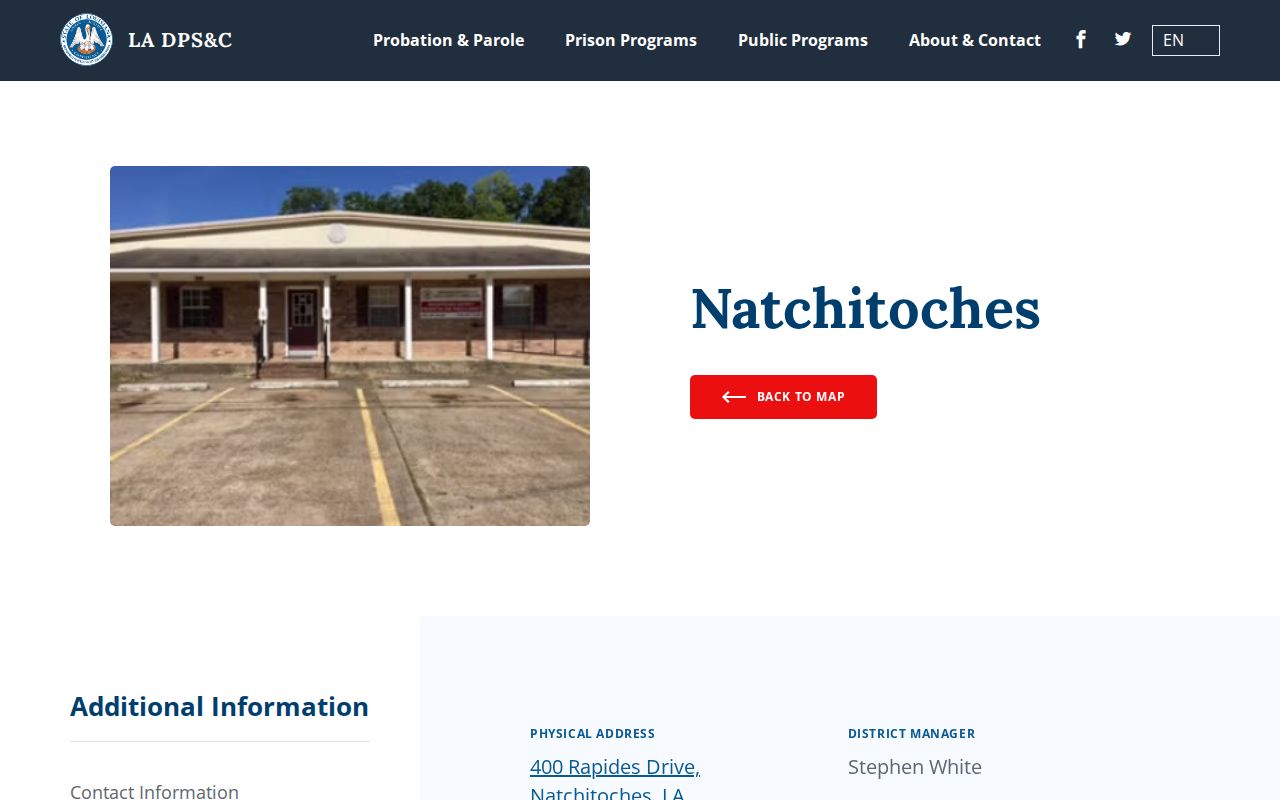
The page is an office-navigation source. It does not establish any one person’s status, officer, conditions, eligibility, or release date.
Natchitoches Probation and Parole District Office
400 Rapides Drive
Natchitoches, LA 71457
318-332-8487
Monday through Friday, 8:00 a.m. to 4:30 p.m.
Manager: Stephen White
Public staff may limit person-specific information. Ask whether this is the assigned district and which official channel can correct or clarify the record. The office page reports nearly 2,000 people and about 154 sex offenders across all five parishes, not Natchitoches Parish alone, so those district figures should never be treated as parish counts.
Natchitoches Parish Parole Reporting Rules
DPS&C states a general rule that parolees report no later than 48 hours after release and submit monthly reports by the fifth. Those statements describe the statewide framework. The person’s release papers, assigned officer, and individual conditions control the actual instructions. A family member or friend should not replace those case-specific directions with a general web summary.
Conditions may address reporting, residence, travel, treatment, payment, contact, or other court and agency requirements. The exact terms depend on the order and case. A violation may lead to an officer response, warrant, hearing, or custody change, but the public status alone does not reveal the full sequence. Louisiana publishes separate parole revocation schedules and results. Those materials relate to revocation proceedings and should not be read as a live list of every person with a supervision concern.
Does a parole label prove release from the parish jail? It supports a community-supervision conclusion at the record’s update time. The NPSO release entry is still the better source for the date, time, type, and destination of the actual Natchitoches Parish custody exit.
What Reentry Help Exists in Natchitoches Parish?
The Natchitoches district’s role starts before some releases. Its official page describes monthly pre-release courses in parish detention facilities, orientation meetings, officer participation in the 10th Judicial District Court Probation Support Group, and coordination with local Drug Court. The district also participates in a local law-enforcement roundtable. These facts show that post-release navigation may connect custody, courts, treatment, and supervision rather than ending at the jail door.
The 10th JDC Drug Court offers treatment, counseling, and aftercare referrals in the setting described by the district. The office page also notes that an Inmate Welfare Fund may provide certain day-to-day essentials to eligible parolees. None of these programs or items is automatic. Eligibility, current availability, referrals, and terms must come from the district or court program itself.
For practical help, begin with the assigned officer or the Natchitoches office rather than relying on a general program description. Orientation and pre-release instruction are navigation points, not promises that a particular person will receive a placement, service, or payment.
Note: Local reentry programs support a transition, but participation does not establish that parole, probation, or the underlying sentence has ended.
Natchitoches Parish Release Warrant Checks
Yes. Release verification and warrant verification are separate tasks. A person can be outside the Natchitoches Parish Detention Center while a court case continues, and a later warrant may relate to supervision, a missed appearance, or another matter. Louisiana DPS&C’s Most Wanted page is a limited public lead. It is not a complete statewide warrant database, and absence from it is not proof of compliance or an all-clear result.
The NPSO Warrants Department reports processing about 1,200 warrants per year. NPSO publishes 318-357-7808 and 318-357-7809 for weekdays from 8:00 a.m. to 4:30 p.m., plus 318-352-6432 after hours. That annual figure describes the local department’s workload, not parole violations or unique people.
When the question is whether someone was released, ask Corrections or Records for the release transaction. When it is whether a warrant exists, use the warrant channel and relevant court record. Combining the questions can cause a valid release event to be mistaken for proof that every legal restraint ended.
Natchitoches Parish Supervision Alerts
LAVNS can show DPS&C community supervision and participating local custody information. From the correct person’s record, users may register through the phone, email, or text options offered by the live interface. A status alert can preserve when the system reported a move, release, or change. It does not explain the release authority, prove full discharge, or replace direct contact with the supervising district.
Louisiana also operates formal Victim Outreach for qualifying victims or designated persons who need state-DOC notices involving projected or actual release, hearings, escape, death, or transitional-work placement. That registration is separate from ordinary LAVNS alerts. The two systems should not be treated as interchangeable.
How Natchitoches Parish Supervision Ends
Physical release, supervision completion, and full discharge can occur on different dates. The jail’s record establishes when a person left its custody and whether the exit was bond, transfer, time served, parole-related, or another recorded event. The LAVNS result may show community supervision. The supervising district can address the current assignment. A final discharge record addresses the end of the applicable sentence or supervision status.
For a state case, R.S. 15:574.12 generally protects much of the prison record, but subsection (G)(1)(a) makes the person’s discharge date public. A narrow request to Louisiana DPS&C can ask for that date without seeking the confidential prison file. State adult-offender records covered by R.S. 44:36 have a six-year retention rule after full-term expiration or death, whichever occurs first. Retention does not make every part of the record public.
Louisiana public-record rules also distinguish access from production. R.S. 44:32 permits inspection during regular hours and allows exempt details to be separated or redacted. R.S. 44:33 addresses presentation of an available record and a prompt certification when it is in active use. These rules do not make confidential supervision or prison-file details public. A focused request for the discharge date is more accurate than asking for an entire file.
A parole grant also does not prove the date a person physically left. Conditions, processing, or a detainer can delay or redirect the movement. For the clearest conclusion, match the release transaction, current supervision label, assigned district, and discharge date instead of turning any single screen into a complete sentence history.
Public Record Search
Sponsored Results